
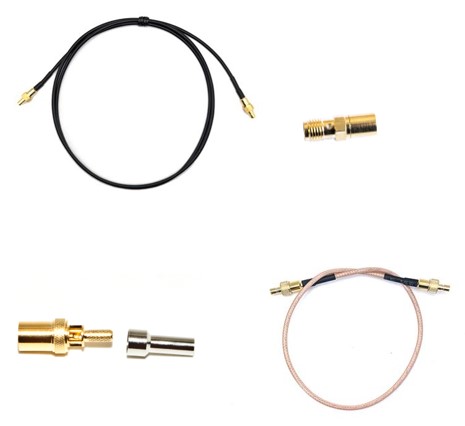
Frequency Range | Ideal for 5G, Radar, and Test Applications
Why frequncy ranges matters when choosing an SMA connector
The SMA (SubMiniature version A) coaxial connector is one of the most widely used RF connectors for high-frequency signal transmission. It’s commonly found in wireless communication, test equipment, radar systems, and 5G infrastructure.
In most cases, standard SMA connectors support frequencies from DC up to 18GHz, while advanced versions can reach 26.5GHz or even higher.
- Standard SMA Connector Frequency Range: DC to 18GHz
- Most commercially available SMA connectors are designed to support frequencies up to 18GHz. Their performance depends on several key design aspects:
- Internal structure: Precise geometry and dielectric materials are essential for high-frequency transmission
- Conductive materials: Gold-plated contacts reduce signal loss and improve durability
- Impedance matching: A standard 50Ω impedance helps minimize return loss and maintain signal integrity
- This frequency range is sufficient for most Wi-Fi, LTE, and RF testing applications.
- Most commercially available SMA connectors are designed to support frequencies up to 18GHz. Their performance depends on several key design aspects:
- High-Frequency SMA Connectors: Up to 26.5GHz and Beyond
- With the rise of millimeter-wave, 5G, and radar technologies, 18GHz is no longer enough for some systems. Enhanced SMA connectors achieve higher performance through:
- Extended frequency support: Up to 26.5GHz or more for mmWave radar, 5G base stations, and advanced testing systems
- High-precision manufacturing: Minimizes mechanical variation for more stable high-frequency response
- Low-loss materials (like PTFE): Reduce signal attenuation and boost efficiency
- Optimized contact design: Maintains reliable electrical performance even at very high frequencies
- With the rise of millimeter-wave, 5G, and radar technologies, 18GHz is no longer enough for some systems. Enhanced SMA connectors achieve higher performance through:
- Matching SMA Frequency Performance with Your Application
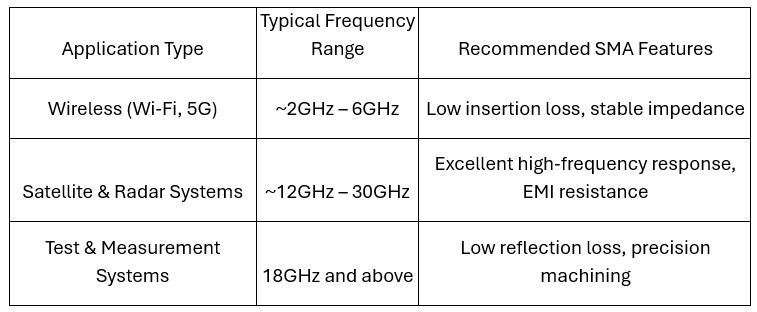
- Choosing the right SMA connector isn’t just about frequency specs—it’s about ensuring system stability. Here’s a breakdown of frequency needs by application:
- 4. Key Factors That Impact SMA Connector Frequency Performance
- To ensure stable performance at high frequencies, consider these critical design factors:
- Contact precision: Poor alignment or substandard contact can increase reflection and signal loss
- Dielectric materials: Low-loss materials like PTFE or PEEK are crucial for minimizing attenuation
- Manufacturing tolerances: Higher precision equals better frequency consistency and repeatability
- To ensure stable performance at high frequencies, consider these critical design factors:
Conclusion: Match the Connector to the Application for Optimal RF Performance
The frequency capabilities of an SMA connector are determined by its design accuracy, material selection, and manufacturing quality.
For high-frequency environments like 5G, radar, and test systems, selecting a 26.5GHz-class high-performance SMA connector is key to maintaining signal quality and system reliability.